
welcome to the hub
The Lumaris Hub
Practical insights, tools, and real-world lessons for leaders navigating AI adoption. Explore guides, diagnostics, and articles designed to help you simplify operations and scale smarter.
This page will grow over time as new resources are added.
FEATURED GUIDE
Win Back 1 Hour a Day
A Simple, Practical AI Guide for Small Business Owners
A practical introduction for small business owners who want to understand where AI can reduce everyday workload — without adding complexity or overwhelm.
Prefer something interactive?

Latest Insights
Short reads and practical ideas to help leaders cut through the noise around AI.
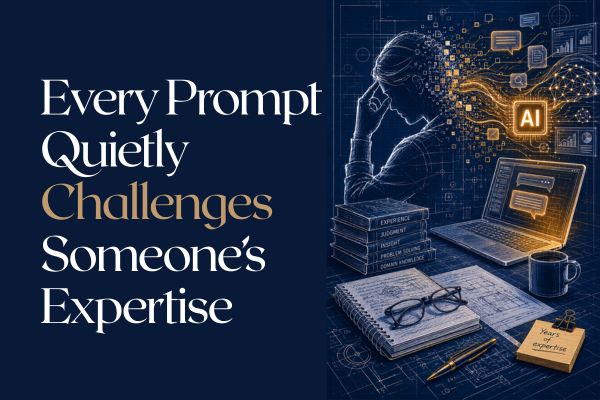
Every Prompt Quietly Challenges Someone’s Expertise
AI transformation is often discussed like a technology problem.
A tooling problem.
A workflow problem.
A governance problem.
A training problem.
But underneath all of that sits something far more human.
Every prompt quietly challenges someone’s expertise.
That is the part many organizations still struggle to acknowledge openly.
Not because employees are irrational.
And not because people are unwilling to learn.
Because expertise is deeply personal.
It represents:
years of experience
earned credibility
professional identity
accumulated judgment
hard-won pattern recognition
organizational value
For many people, expertise is not simply what they do.
It is who they are.
So when AI suddenly:
drafts in seconds
summarizes instantly
structures ideas
analyzes documents
generates first-pass work
accelerates decisions
…it quietly changes the perceived value of work that once required years to develop.
That creates tension organizations rarely discuss directly.
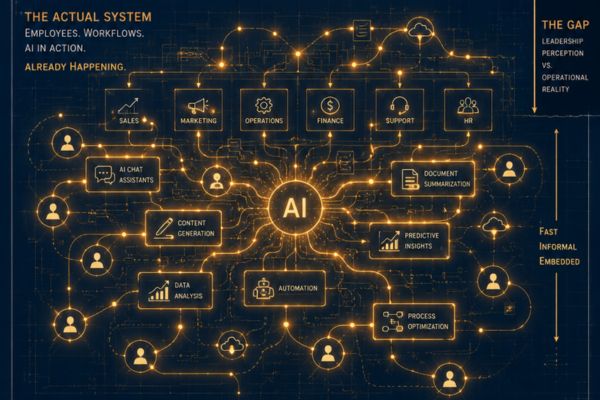
The Resistance Is Often Silent
One of the biggest misconceptions in AI transformation is that resistance will appear loudly.
Sometimes it does.
But increasingly, it does not.
Instead, resistance becomes operationally quiet.
People:
stop experimenting
stop sharing prompts
disengage from new workflows
avoid discussing concerns
continue old processes privately
comply publicly while opting out operationally
From leadership’s perspective, the rollout may still appear successful.
The meetings happened.
The tools launched.
The training sessions were completed.
The dashboards look positive.
Meanwhile, actual adoption quietly slows underneath the surface.
Not because employees are incapable.
Because psychologically, many are still trying to understand what AI means for:
their role
their expertise
their relevance
their future contribution
Leadership Often Misses the Real Friction
Most organizations focus heavily on:
AI policies
approved tools
governance frameworks
implementation roadmaps
use cases
productivity targets
Those things matter.
But many transformation efforts fail because they underestimate the human adaptation layer entirely.
The real friction often sits somewhere else:
trust erosion
identity uncertainty
fear of becoming replaceable
fear of exposing capability gaps
fear of losing professional value
fear of losing control over expertise
And because these concerns are emotionally complex, employees rarely articulate them directly.
Especially inside high-performing corporate environments where adaptability is expected.
So instead, resistance becomes subtle.
Quiet.
Operational.
This Is Why AI Transformation Is Not Just a Technology Rollout
Organizations often treat AI adoption like previous software deployments.
Train the teams.
Roll out the tools.
Track usage metrics.
But AI changes something deeper than process efficiency.
It changes how expertise itself is perceived.
That requires a different kind of leadership.
Because successful AI transformation is not simply about deploying more technology.
It is about creating environments where people feel:
psychologically safe
operationally supported
trusted to evolve
included in redesign conversations
able to grow alongside the technology
The organizations moving fastest with AI are not necessarily the ones with the most tools.
They are often the ones creating the safest conditions for adaptation.
The Quiet Risk Organizations Underestimate
When employees feel their expertise is being reduced to something easily reproducible, organizations unintentionally create:
disengagement
withholding of insight
slower experimentation
reduced collaboration
performative adoption
hidden resistance
This becomes especially dangerous because leadership may not immediately see it.
The transformation appears active externally while internally momentum quietly weakens.
That is one of the biggest hidden risks in enterprise AI adoption today.
The Organizations That Succeed Will Handle This Differently
The companies that succeed with AI long term will not simply ask:
“How do we deploy AI faster?”
They will also ask:
“How do we help people redefine where their value grows next?”
Because real transformation does not happen when employees feel replaceable.
It happens when they understand how their expertise evolves alongside AI instead of disappearing beneath it.
That is not a technology challenge.
It is a leadership challenge.
And increasingly, it may become the defining challenge of enterprise AI transformation itself.
Want to understand whether your organization is operationally ready for AI transformation?
The AI Infrastructure Readiness Index™ helps leadership teams identify the operational, governance, workflow and adoption gaps that often remain invisible until transformation efforts begin to stall.
Start here:
AI Infrastructure Readiness Index™


The AI Readiness Brief
Practical AI insights for leaders building AI-ready organizations.
FOLLOW US

COMPANY
CUSTOMER CARE
LEGAL
Copyright 2026. Lumaris AI Solutions Inc. Alberta, Canada. All Rights Reserved.