
welcome to the hub
The Lumaris Hub
Practical insights, executive publications, and real-world lessons for leaders navigating AI readiness. Explore The Bridge, practical guides, and upcoming executive briefings designed to help you build organizational readiness—not just adopt new technology.
A growing library of ideas, insights, and resources designed to help leaders bridge the AI readiness gap.
FEATURED PUBLICATION
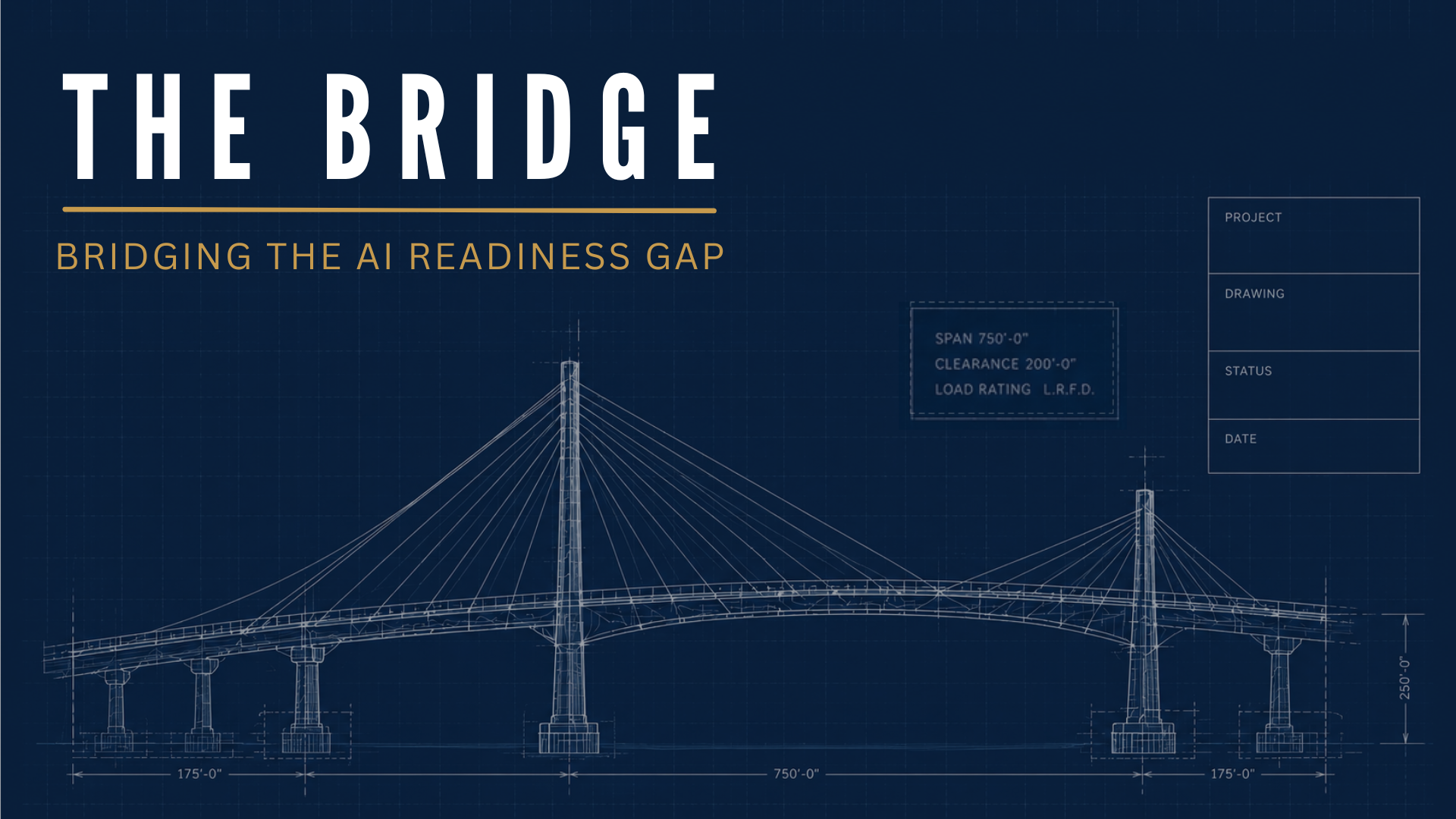
The Bridge
Bridging the AI Readiness Gap
A monthly executive publication exploring AI readiness through practical stories, leadership insights, and real-world examples.
New issues published monthly.
Latest from The Bridge
Fresh perspectives, practical stories, and leadership insights to help you bridge the AI readiness gap.
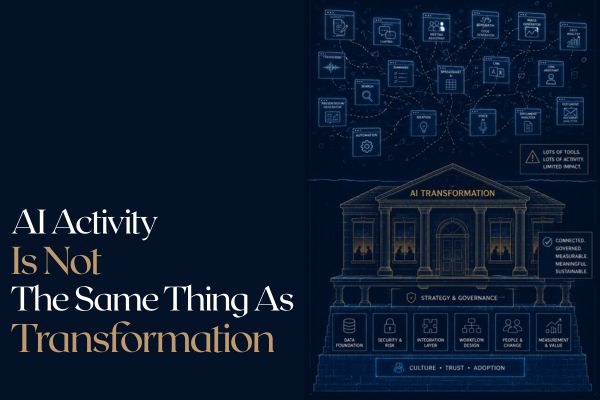
AI Activity Is Not the Same Thing as AI Transformation
Many organizations are mistaking AI activity for AI transformation.
The distinction matters more than most leadership teams realize.
Because deploying tools is not the same thing as creating operational change.
And right now, many organizations are accumulating AI activity rapidly while generating surprisingly little measurable transformation underneath it.
AI Activity Is Easy to Create
Today, organizations can deploy AI tools incredibly quickly.
Within months, teams may suddenly have:
copilots
AI assistants
content generators
transcription tools
workflow automations
meeting summaries
AI-powered dashboards
isolated departmental use cases
From the outside, this can look like rapid AI adoption.
The organization appears innovative.
Employees appear engaged.
Leadership feels momentum.
But underneath the surface, something important is often missing:
Connection.
Tools Alone Do Not Create Transformation
Many organizations now have dozens of AI tools operating simultaneously with:
no shared operational architecture
no workflow redesign
no integrated governance
no enterprise visibility
no measurement framework
no strategic alignment
no operational orchestration
As a result, AI becomes fragmented.
Different departments experiment independently.
Workflows evolve inconsistently.
Data flows remain disconnected.
Use cases stay isolated.
The organization accumulates activity without building transformation infrastructure.
That distinction is critical.
Because tools can create motion without creating measurable enterprise value.
AI Transformation Requires Infrastructure
Real transformation happens when AI becomes intentionally embedded into:
workflows
operational systems
governance structures
decision-making processes
measurement models
data architecture
organizational behavior
That requires more than experimentation.
It requires infrastructure.
Not just technical infrastructure.
Operational infrastructure.
The organizations seeing the strongest results with AI are usually not the ones deploying the highest number of tools.
They are the ones building:
connected systems
integration layers
operational alignment
governance maturity
sustainable workflows
measurable adoption models
In other words:
they are building architecture, not just activity.
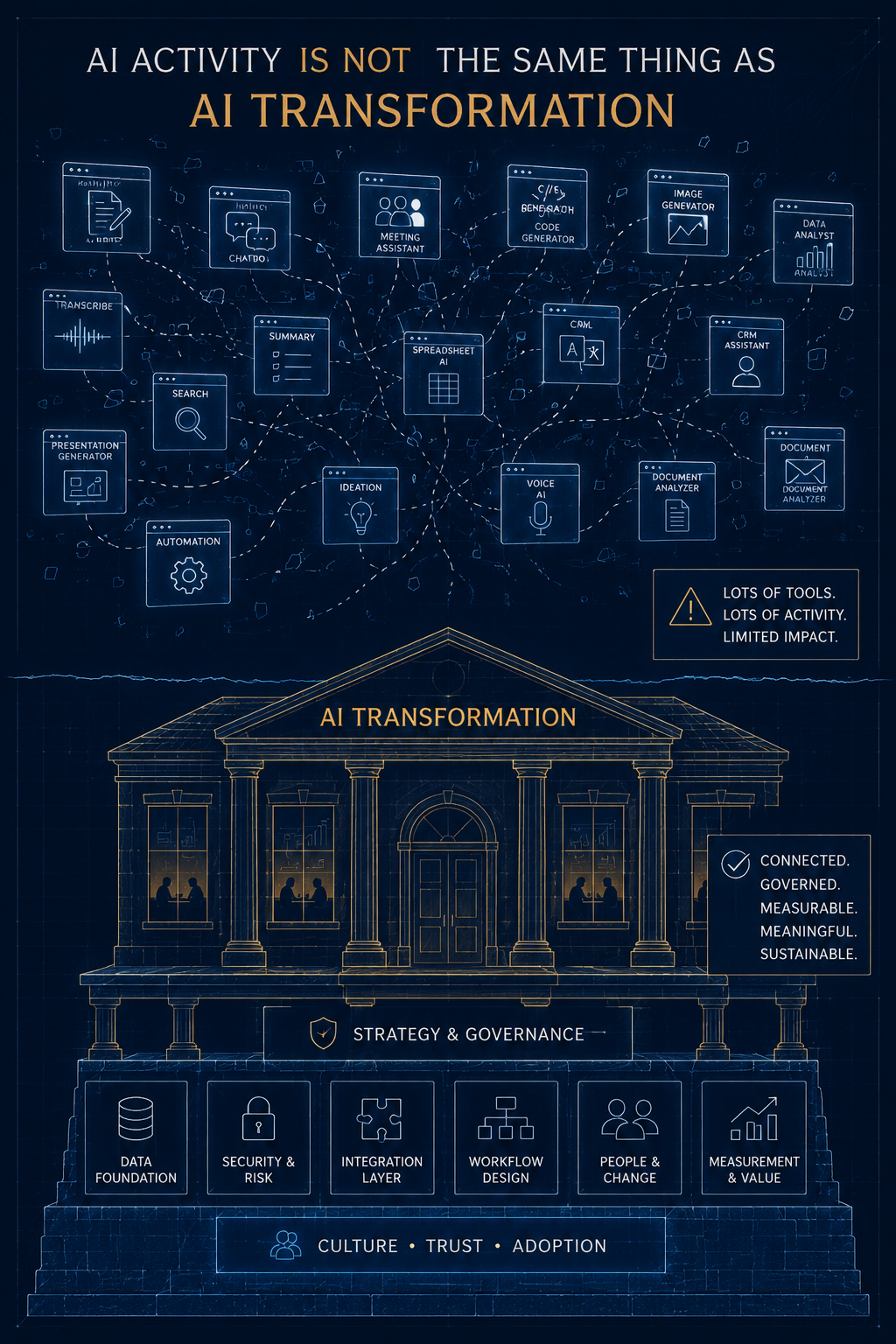
Fragmented AI Adoption Creates Hidden Organizational Risk
Disconnected AI activity often creates:
duplicated effort
inconsistent outputs
operational confusion
workflow fragmentation
Shadow AI behavior
governance blind spots
low visibility
stalled adoption
limited measurable impact
Ironically, organizations can appear highly active in AI externally while internally struggling to generate meaningful enterprise outcomes.
This is one of the biggest reasons many AI initiatives stall after early experimentation phases.
The issue is not necessarily lack of enthusiasm.
It is lack of operational integration.
The Most Mature AI Organizations Think Systemically
The organizations moving fastest with AI are increasingly treating AI as:
an operational transformation layer
not simply a software category
That changes the conversation entirely.
Because instead of asking:
“What AI tools should we deploy?”
They begin asking:
How do workflows change?
How do teams collaborate differently?
How do we govern responsibly?
How do we measure impact?
How do we integrate systems?
How do we scale adoption sustainably?
How do we redesign operations intentionally?
That is where real transformation begins.
AI Transformation Is Not About Collecting Tools
Many organizations are currently operating inside:
tool accumulation mode.
The organizations gaining long-term advantage are operating inside:
operational transformation mode.
That difference becomes increasingly important as AI capabilities accelerate.
Because eventually, the competitive advantage will not come from simply having access to AI tools.
Most organizations will.
The advantage will come from:
connected operational systems
integrated workflows
responsible governance
measurable adoption
organizational alignment
scalable execution
In other words:
the infrastructure beneath the tools.
Tools Create Activity.
Architecture Creates Transformation.
That may become one of the defining operational realities of enterprise AI over the next several years.
Because organizations that fail to build connected AI infrastructure risk creating:
fragmented adoption
operational complexity
governance confusion
isolated experimentation
limited business impact
Meanwhile, organizations that build intentional operational architecture around AI will compound capability across the enterprise.
That is the difference between:
using AI
and
transforming with AI.
Want to understand whether your organization is operationally ready for sustainable AI transformation?
The AI Infrastructure Readiness Index™ helps leadership teams identify the operational, governance, workflow and adoption gaps that often remain hidden beneath surface-level AI activity.
Start here:
AI Infrastructure Readiness Index™


The Bridge
A monthly publication sharing practical stories and leadership insights to bridge the AI readiness gap.
FOLLOW US

COMPANY
CUSTOMER CARE
LEGAL
Copyright 2026. Lumaris AI Solutions Inc. Alberta, Canada. All Rights Reserved.