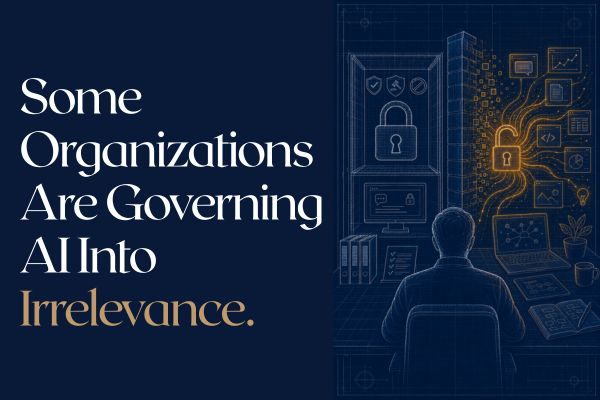
Some Organizations Are Governing AI Into Irrelevance
Most organizations understand that AI introduces risk.
That part is true.
The problem is that many organizations are now responding to that risk in ways that unintentionally suppress the very transformation they are trying to enable.
They approve AI in principle.
But operationally, employees are often restricted into environments so limited that meaningful adoption never truly happens.
That is not AI transformation.
That is controlled experimentation at the edges.
And increasingly, it is creating a new kind of organizational problem:
AI adoption that exists officially, but barely functions operationally.
“We Use AI” Is Becoming a Misleading Statement
Many organizations now say:
“We use AI.”
But when you look closer, employees are often:
restricted to heavily constrained environments
limited to a small subset of tools
blocked from modern workflows
prevented from experimenting meaningfully
operating inside rigid governance layers that prioritize control over capability
Meanwhile, the actual productivity breakthroughs employees see outside those environments are happening somewhere else entirely.
This creates a dangerous disconnect between:
official AI strategy
andoperational AI reality.
Governance Is Necessary
But Governance Without Operational Understanding Creates Friction
This is not an argument against governance.
Responsible AI governance matters deeply.
Organizations absolutely need:
security controls
privacy standards
risk management
compliance frameworks
data protection
operational safeguards
But governance becomes counterproductive when it is designed primarily around fear instead of operational understanding.
Because AI adoption does not happen inside policy documents.
It happens inside workflows.
Inside:
daily decisions
repetitive tasks
collaboration
experimentation
process redesign
operational problem-solving
And when employees are prevented from using modern tools in ways that meaningfully improve work, organizations unintentionally create:
adoption fatigue
low experimentation
stagnant workflows
performative AI usage
growing Shadow AI behavior
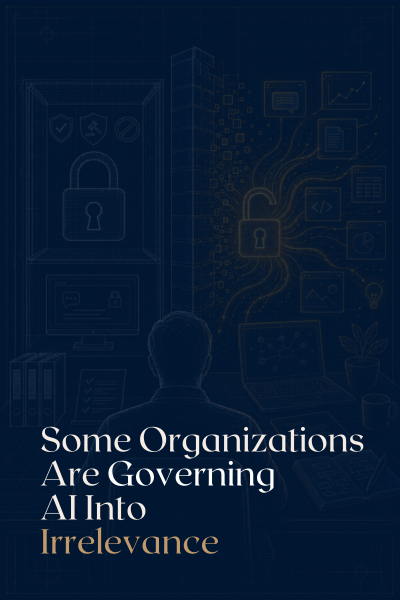
AI governance: innovation vs constraints
Restricting Capability Is Not the Same as Managing Risk
I am increasingly seeing organizations:
ban commonly used platforms because AI features were introduced
restrict employees to narrow “approved” environments
limit experimentation so heavily that AI becomes operationally impractical
force teams into workflows that technically satisfy governance requirements while delivering minimal transformation value
The result?
Employees may technically have “AI access” while operationally remaining far removed from the real capability modern AI tools now offer.
That creates a false sense of maturity.
Leadership believes:
“We’ve implemented AI.”
Meanwhile, employees quietly conclude:
“This is too limited to meaningfully help me.”
That is where adoption begins to stall.
The Organizations Moving Fastest Are Balancing Governance and Capability
The organizations creating meaningful AI transformation are not ignoring governance.
They are building governance systems that still allow:
experimentation
operational learning
workflow redesign
capability discovery
responsible innovation
Because they understand something important:
AI transformation does not happen when employees are only allowed to operate inside highly constrained environments with minimal practical value.
Transformation happens when organizations create:
visibility
guardrails
operational trust
responsible enablement
modern workflows
adaptive governance models
The goal should not be:
“How do we eliminate all AI risk?”
The goal should be:
“How do we enable responsible capability at scale?”
Those are very different strategies.
Over-Restricting AI Often Creates the Very Risk Organizations Fear
When governance becomes too rigid:
employees stop experimenting openly
unofficial tools emerge
Shadow AI increases
workarounds grow
operational visibility declines
adoption becomes fragmented
Ironically, organizations trying hardest to tightly control AI sometimes create the least visible AI environments operationally.
Because employees still need to solve problems.
Work still needs to move.
And if official systems become too limiting, operational work simply routes around them.
AI Transformation Requires More Than Permission
The organizations that succeed with AI long term will not simply:
approve AI tools
publish governance policies
limit access
restrict experimentation
They will create operational systems where:
governance exists
risk is managed
employees are enabled responsibly
experimentation is visible
workflows evolve intentionally
capability can actually compound
Because the companies gaining the most value from AI are not the ones governing the hardest.
They are the ones governing intelligently enough to still allow transformation to happen.
Want to understand whether your organization is operationally ready for AI transformation?
The AI Infrastructure Readiness Index™ helps leadership teams identify operational, governance, workflow and adoption gaps before AI efforts begin to stall under hidden friction.
Start here:
AI Infrastructure Readiness Index™

