Shadow AI Is Often an Operational Problem Before It Becomes a Governance Problem
Most conversations around Shadow AI focus on risk.
Unauthorized tools
Unapproved systems
Data exposure
Governance gaps
Those concerns are valid.
But they often miss an important reality:
Most employees are not using unofficial AI tools because they are trying to break policy.
They are using them because the official path no longer supports how work actually happens.
That distinction matters.
Because Shadow AI frequently appears as an operational signal long before it becomes a governance issue.
What Shadow AI Actually Reveals
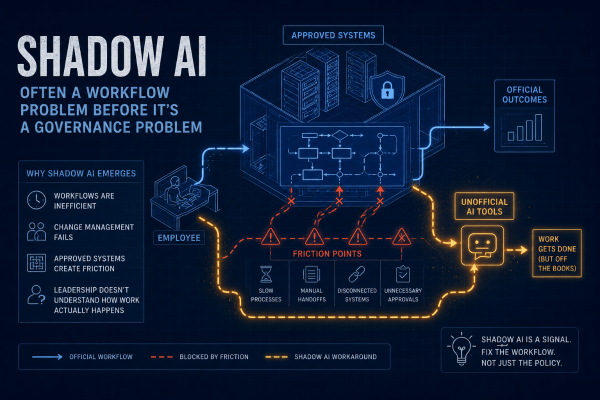
When employees route around official systems, they are usually trying to solve one of four things:
friction
delay
repetitive work
workflow inefficiency
A slow approval process.
A disconnected reporting workflow.
A system that requires five manual steps to complete something AI can assist with in seconds.
A process leadership believes is working well — but employees experience very differently.
This is why Shadow AI tends to emerge fastest inside organizations where:
workflows are outdated
operational bottlenecks already exist
teams feel pressure to move faster
change management lacks operational understanding
leadership designs systems too far from the work itself
In those environments, employees adapt.
Not maliciously.
Practically.
The Pattern Organizations Keep Missing
Many organizations treat Shadow AI as a compliance issue first.
So the response becomes:
tighter restrictions
stricter controls
broader warnings
more policy documentation
But policy alone rarely resolves the underlying behavior.
Because the behavior is often rooted in operational friction.
People will consistently route around systems that create unnecessary drag.
Especially under pressure.
This is not new.
Organizations saw the same thing with:
shadow IT
personal spreadsheets
unofficial messaging platforms
disconnected process workarounds
The difference now is that AI accelerates capability much faster.
Which means unofficial systems can scale quickly inside the organization before leadership even realizes they exist.
Why Leadership Teams Need to Pay Attention
Shadow AI exposes something many organizations still struggle to see clearly:
There is often a gap between how leaders think work happens and how work actually happens.
Employees usually understand operational friction long before executives do.
That’s why workflow clarity matters.
That’s why operational visibility matters.
And that’s why AI adoption cannot be treated as simply a technology rollout.
It is a workflow redesign challenge.
A change management challenge.
A leadership alignment challenge.
And increasingly, a governance challenge as well.
Governance Still Matters — But Timing Matters Too
This is not an argument against governance.
Strong AI governance is critical.
Organizations absolutely need:
clear usage policies
data handling standards
accountability structures
risk oversight
leadership visibility
But governance works best when it is paired with operational understanding.
Otherwise organizations risk solving only the visible symptom while leaving the underlying friction untouched.
The Organizations That Will Handle This Best
The organizations that succeed with AI over the next few years will not necessarily be the ones with the strictest controls.
They will be the ones that:
understand how work actually flows through the business
reduce unnecessary operational friction
align systems to real workflows
create psychologically safe adoption environments
design governance into operations early
Because unofficial systems rarely emerge in a vacuum.
They emerge where operational gaps already exist.
And increasingly, Shadow AI is revealing exactly where those gaps are.
If your organization is exploring how AI readiness, operational clarity, and workflow design intersect, you can explore the AI Infrastructure Readiness Index here:

