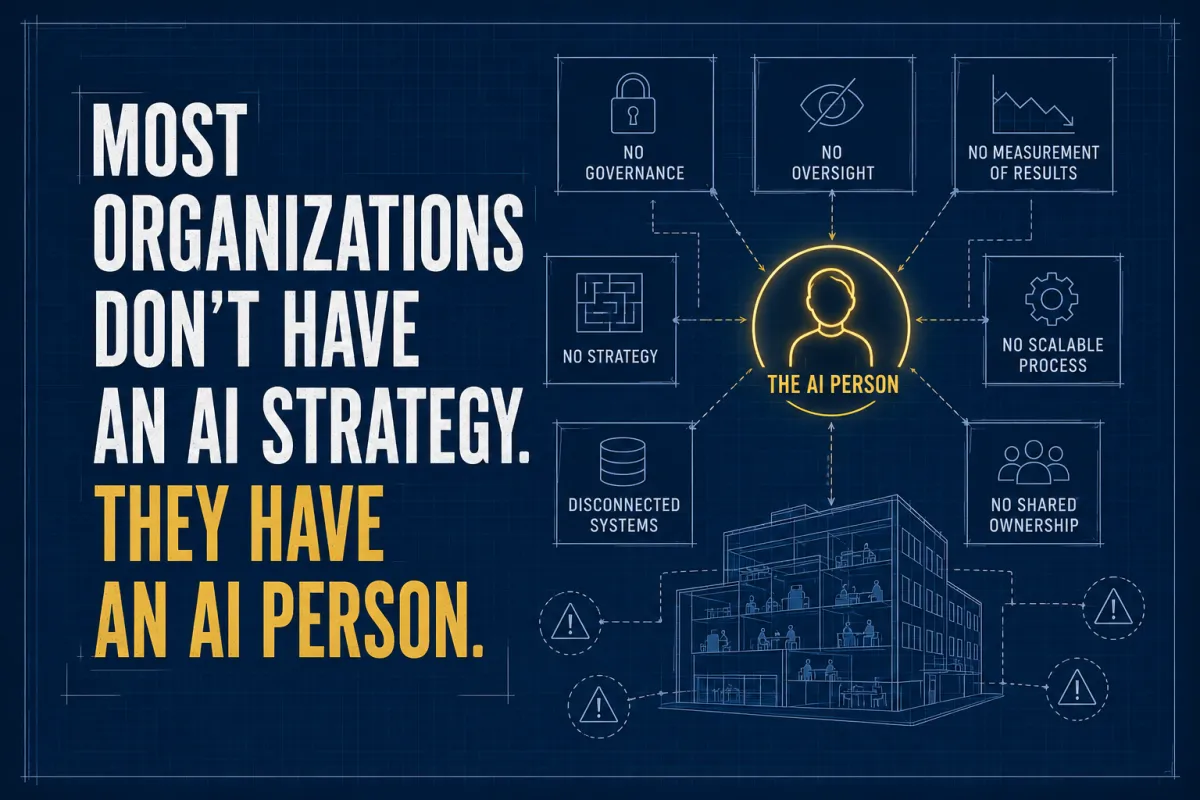
Most Organizations Don’t Have an AI Strategy. They Have an AI Person.
There’s a pattern emerging across organizations right now that I keep seeing repeatedly in AI transformation conversations.
Leadership says:
“We’re already using AI.”
But when you look closer, what they often mean is:
“We have one person experimenting with AI tools.”
One employee is using ChatGPT.
One department is testing automations.
One technically curious team member has become the unofficial “AI person.”
And while that may create isolated wins, it is not the same thing as organizational AI readiness.
Because one person is not a strategy.
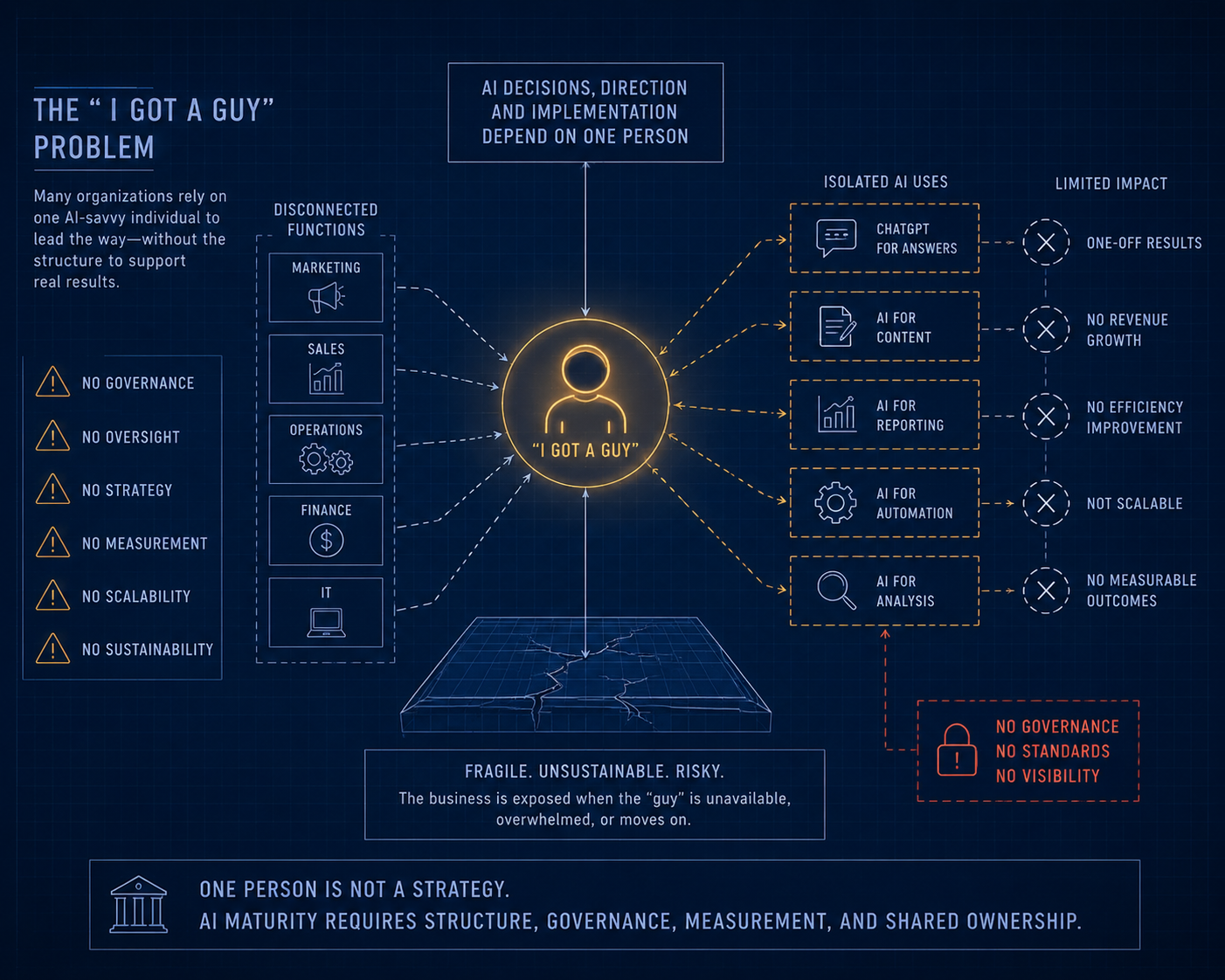
The “I Got a Guy” Problem
Most organizations do not intentionally create this situation.
It usually starts with curiosity and good intentions.
Someone internally begins experimenting with AI:
building prompts
testing automations
summarizing meetings
generating content
streamlining small tasks
exploring workflows
Leadership notices the enthusiasm and starts routing AI-related questions through them.
Soon the organization begins saying:
“We’ve got someone handling AI.”
That creates a dangerous illusion of maturity.
Because while AI activity exists, the organization itself has not fundamentally changed.
There is often:
no governance
no operational strategy
no adoption framework
no measurement of impact
no enterprise-wide visibility
no redesign of workflows
no scalable implementation plan
Just isolated experimentation.
Why Organizations Fall Into This Trap
The reality is that AI feels overwhelming for many leaders.
The technology is moving quickly.
The terminology changes constantly.
New tools appear weekly.
Relying on an internal “AI person” feels safe because it lowers the perceived complexity.
It creates the impression that progress is happening without requiring organizational transformation.
But AI is not simply:
a software rollout
an IT project
a productivity tool
or a collection of prompts
AI changes:
workflows
decision-making
operational models
governance structures
workforce expectations
information flow
accountability
customer experience
and how value gets created across the enterprise
That cannot sit on one person’s shoulders.
The Hidden Risks of “AI by Volunteer”
This is where organizations begin creating unintended fragility.
When AI adoption depends on one enthusiastic employee, several things usually happen:
1. Shadow AI Emerges
Teams begin using unauthorized tools and disconnected workflows because approved systems create too much friction.
2. Knowledge Becomes Centralized
Critical operational knowledge sits with one employee instead of being embedded into systems and processes.
3. Governance Falls Behind
Data handling, compliance, security, and oversight become reactive instead of intentional.
4. AI Becomes Fragmented
Different departments experiment independently with no shared standards, priorities, or measurement.
5. Leadership Mistakes Activity for Transformation
The organization appears innovative externally while operationally remaining unchanged internally.
And perhaps most importantly:
If the “AI person” leaves, momentum often disappears with them.
That is not maturity.
That is dependency.
What Real AI Readiness Looks Like
The organizations seeing measurable AI outcomes are typically not the ones talking about AI the most.
They are the ones building operational infrastructure around it.
Real AI readiness includes:
workflow redesign
leadership alignment
governance frameworks
change management
workforce enablement
operational integration
shared ownership
measurable business outcomes
and ongoing adaptation
In other words:
AI maturity is not measured by whether someone in the company uses AI.
It is measured by whether the organization can operationalize it repeatedly, responsibly, and at scale.
That requires leadership.
That requires structure.
And increasingly, it requires organizations to stop treating AI as a side experiment and start treating it as an enterprise transformation layer.
Final Thought
AI transformation cannot depend on “the AI guy.”
Sustainable results require more than isolated experimentation. They require operational readiness: leadership alignment, governance, workflow redesign, operational clarity, measurable outcomes, and shared ownership across the organization.
That’s exactly why I created the AI Infrastructure Readiness Index™ — to help leaders identify the gap between isolated AI activity and scalable organizational transformation.
If your organization is exploring AI, the better question may not be:
“Are we using AI?”
It may be:
“Are we actually built to support it?”

