The AI Readiness Gap Most Leadership Teams Still Can’t See
Many organizations believe they are still “early” in AI adoption.
Their employees disagree.
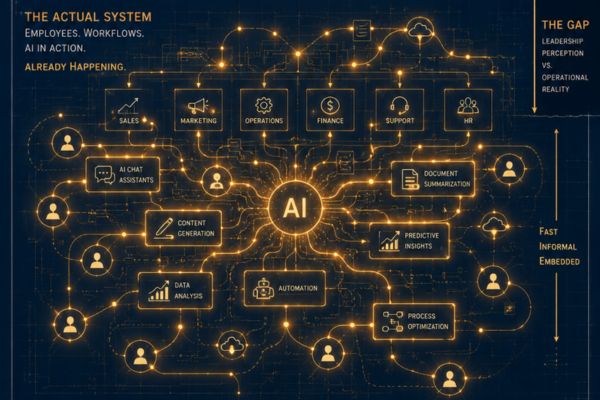
Because while leadership teams are still discussing policies, risks, budgets, and governance frameworks, operational teams are already using AI every day.
Quietly.
Not because employees are reckless.
Because work keeps moving.
And when systems create friction, people naturally look for ways around it.
That is the real AI readiness gap.
Not technology.
Visibility.
AI Adoption Is Already Happening
Across most organizations, employees are already using AI to:
summarize meetings
draft emails
analyze spreadsheets
generate content
automate repetitive work
organize information
accelerate research
improve response times
streamline operational tasks
Much of this is happening informally.
Sometimes without approval.
Sometimes without guidance.
Sometimes without governance.
And often without leadership realizing the scale of it.
This creates a dangerous disconnect between:
official organizational policy
andoperational reality.
The “Official System” Is No Longer the Actual System
One of the biggest mistakes organizations make is assuming AI adoption begins when leadership formally approves it.
In reality, adoption often begins much earlier at the operational layer.
Employees experiment first.
Workflows evolve first.
Unofficial systems emerge first.
Leadership usually discovers it later.
By the time executive teams begin discussing enterprise AI strategy, employees have often already built:
hidden workflows
unofficial processes
side systems
workaround automations
unmanaged data flows
This is why so many organizations believe they are “just starting” with AI while AI usage is already deeply embedded inside the business.
Most Organizations Don’t Have an AI Usage Problem
They have an AI visibility problem.
Because when leadership lacks visibility into:
how employees are using AI
where workflows are changing
which tools are spreading
what operational friction exists
where data risks are emerging
…governance becomes reactive instead of intentional.
That is where Shadow AI begins to grow.
Not because employees are malicious.
Because organizations failed to operationalize adoption properly.
Governance Alone Is Not Enough
Many organizations respond by focusing exclusively on:
restrictions
approvals
security reviews
AI bans
compliance policies
But governance without operational alignment rarely works.
Because if:
workflows remain inefficient
approved tools remain difficult
operational friction remains high
leadership remains disconnected from day-to-day work
…employees will continue finding alternative ways to get work done.
AI adoption is not simply a technology rollout.
It is an operational transformation.
And operational transformations fail when leadership systems lag behind operational reality.
The Organizations Moving Fastest Are Not the Ones Ignoring Risk
They are the ones creating:
visibility
alignment
governance
workflow redesign
responsible enablement
operational integration
They understand something many organizations still miss:
Employees are not waiting for AI transformation to begin.
It already has.
The question is whether leadership is building the systems to support it responsibly.
Closing the Readiness Gap
The organizations that succeed with AI will not necessarily be the ones deploying the most tools.
They will be the ones that:
understand how work is actually happening
align leadership with operational reality
redesign workflows intentionally
operationalize governance early
enable adoption visibly and responsibly
Because the real competitive advantage is not simply adopting AI.
It is closing the gap between:
leadership perception
andoperational reality.
Want to understand where your organization actually stands?
The AI Infrastructure Readiness Index™ was designed to help leadership teams identify operational, governance, workflow, and adoption gaps before they become organizational risk.
Start here:
https://ai-infrastructure-readiness-index.scoreapp.com

